If you’re affected by an eating disorder do you know what emotions you’re trying to manage?
What feelings can’t you bear?
For anyone with ARFID (avoidant restrictive food intake disorder) my thoughts around our emotional dis-ease manifesting in eating disorders symptoms will seem alien. But despite the motivating factors I’d argue that emotional turbulence features with most versions of dis-ordered eating.
Albeit not in the same way.
Everyone's eating disorder experience is different because we are all, fundamentally, unique.
I learnt that life is a journey of emotion and feeling. Feeling emotional states in my body was essential for my recovery. Cos I was mostly numb.
Waking up, physically, felt scary.
I had to learn to surrender and let go, which took years.
Our mind doesn’t feel (even though it likes to run the show) it thinks, and analyses. Our body feels.
Guests on the podcast often cite anxiety.
Anxiety is underpinned by fear.
Fear is underpinned by love.
Love is the bedrock from which we are all hewn.
Tangled up with my fear was rage. Rage is hard to access if you’ve learnt to bottle it. My rage felt terrifying. What was I meant to do with it? Act it out? Trash the therapy room in order to be authentically angry?
My rage and fear felt similar; both rendered me powerful and powerless. An odd paradoxical state I still can’t quite put my finger on.
But out of all the big-hitter emotions, the one that trapped and left me hopeless was shame.
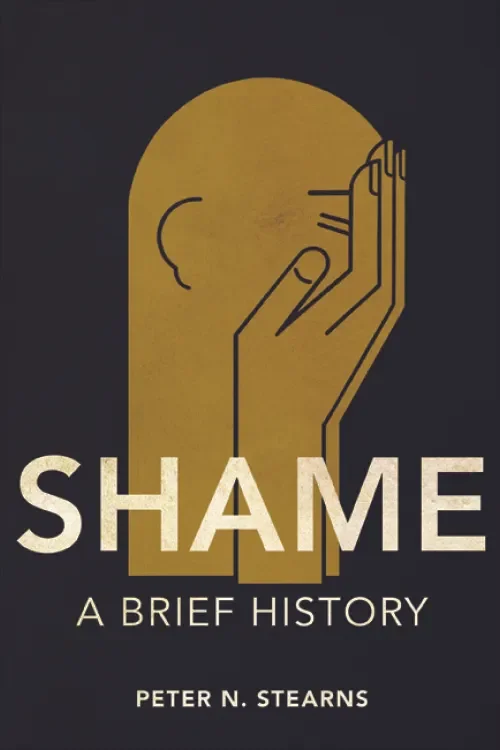
Peter N Stearn writes in his book Shame: A Brief History (History of Emotions, Sept 2017) writes about the “history of shame and how it varies as an individual experience and in its manifestations across time and cultures.”
We need to feel shame in order to take responsibility, change our behaviour individually, and globally. We are all responsible. Accountable for past transgressions, current and future behaviour, on a personal and global scale.
How else can we evolve?
We must feel our shame. Learn from it. So we can move towards something better. Most humans experience shame, on some level, even those with psychopathic traits.
But.. within the context of eating disorders shame behaves like the worst prison warden.
We feel stuck and afraid. So ashamed of our eating disorder stuff, that we’re too ashamed to ask for help. Asking for help means we can’t cope. Then what? We have to let someone else in on our shame. Which, for me, was unthinkable. I chose, like many, to stay in my shame, rather than open up until my situation became (thankfully) unbearable.
How could anyone love me? I'm unlovable/can’t bear myself/am flawed beyond repair/a fake/ashamed to be alive/in this body/of who I really am…
Such erroneous thoughts quickly became the norm. They helped push my shame deep into my belly. When my belly was empty and I felt light I felt no shame.
It was a relief to be trapped by the rigid positions my eating disorder mind claimed as the truth. At least I had a position to take. A model that made sense.
I would’ve told you that I knew exactly who I was - even though it was a lie because I lived in my head and somewhere outside of my body. That’s the thing with eating disorders we are both the teller and the listener. It doesn't matter if we’re dying. As long as we stay true to our rigid ways of thinking.